A growing layer of silent, automated traffic is reshaping how the internet behaves
Zero-click traffic has quietly become one of the most influential forces on the modern internet. These are not attacks triggered by a user or by a visible exploit attempt. They are silent background probes — automated requests arriving without a session, intent, or origin story. They appear out of nowhere, often from cloud platforms, often in bursts, and often with no immediately obvious purpose.
What makes this traffic interesting is not the volume. It’s the structure. When you zoom out far enough, the noise stops looking random and starts forming distinct pathways across global infrastructure.
The Rise of an Invisible Traffic Layer
The internet has always had automated activity. Search engines crawl, uptime monitors check endpoints, and CDNs perform health probes. But over the last few years, automation has surged into something fundamentally different: a global background mesh of micro-requests executed by short-lived cloud instances, serverless functions, and containerized scanning frameworks.
Many of these requests are legitimate. Many are not. And the line between them is increasingly difficult to distinguish.
Today, a significant portion of unsolicited traffic comes from cloud providers where ephemeral compute is cheap, disposable, and spread across dozens of regions. Attackers understand this better than anyone. If an IP gets blocked, they simply respawn the function with a new identity. If a region rate-limits them, they'll pivot to another. The underlying behavior remains identical even as the visible trail constantly changes.
This is why IP-based attribution is losing its meaning. The individual address is irrelevant — the behavior is the fingerprint.
How Zero-Click Pathways Form Across Cloud Networks
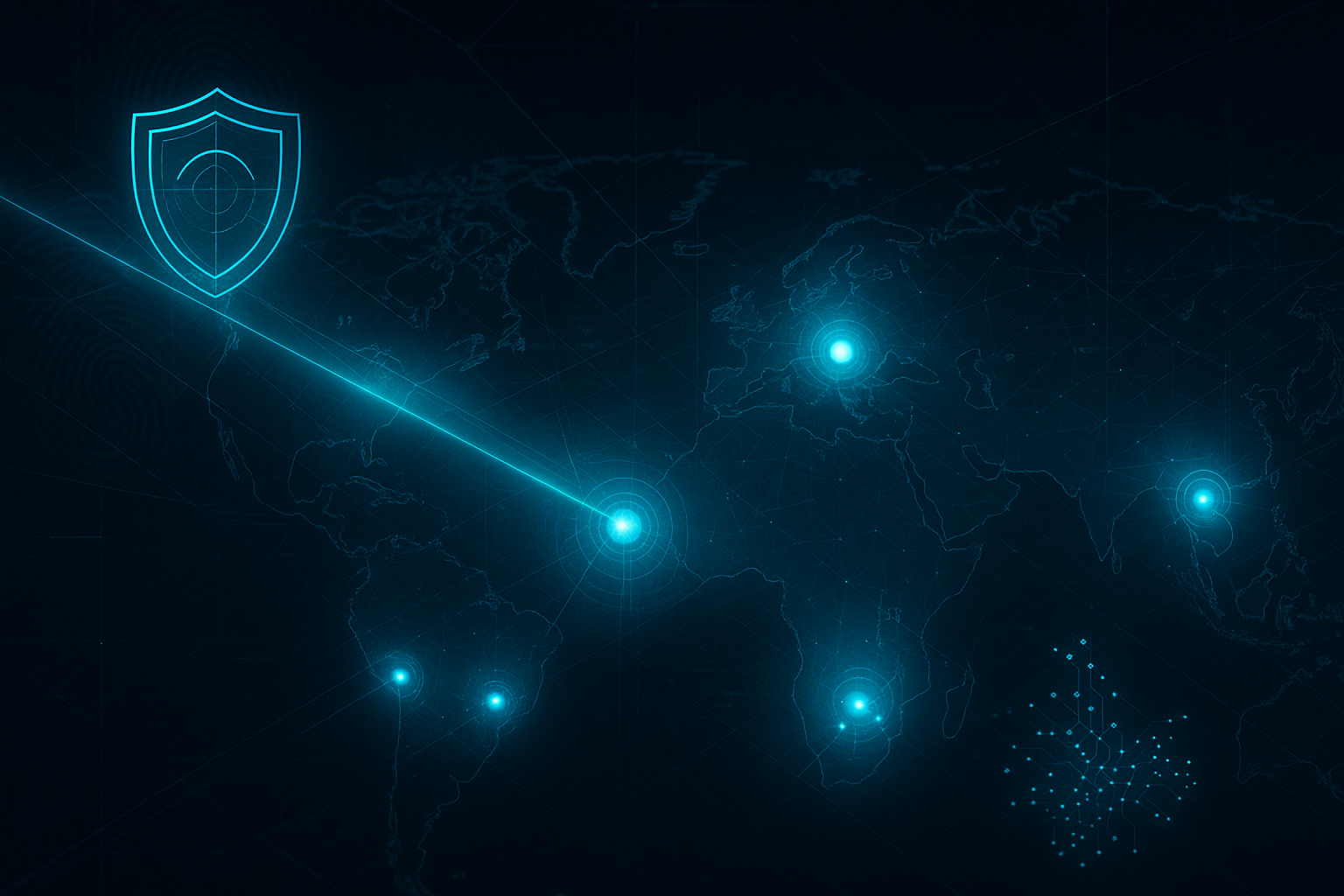
When you examine zero-click traffic at scale, a pattern emerges. Cloud infrastructure creates a kind of “digital terrain” that automated scanners move across. Certain supernets act almost like highways: dense clusters of activity, coordinated in timing and technique, distributed across thousands of rotating identities.
These scanners rarely operate as a single, persistent source. Instead, they appear as hundreds of short-lived shards. One instance sends a single probe and disappears. Another repeats the same request minutes later from a neighboring IP. Viewed individually, each event is meaningless. Viewed together, they reveal an orchestrated sweep.
This pattern is especially common across large cloud ASNs. In some regions, zero-click scanning is so constant that baseline traffic from these subnets resembles a low-level hum — nonstop, predictable, almost rhythmic.
Occasionally, these patterns tighten into waves. A disclosure drops, a new exploit circulates, or a framework updates, and suddenly the same reconnaissance behavior appears across multiple clouds within hours. The traffic shifts like a migrating school of fish, leaving signatures behind that are unmistakably machine-driven.
Behavioral Traits That Give the Automation Away
Even without looking at IPs, you can often tell when a request is part of zero-click automation.
The timing is too perfect.
The paths are too uniform.
The protocol choices are too systematic.
And the entire interaction lacks the messy unpredictability of a real user.
A human browser wanders. Automated flows iterate.
Many zero-click frameworks also behave differently depending on region. One region might attempt only HEAD requests. Another cycles through HTTP versions. Yet another tests for well-known misconfigurations like .env, backup files, admin panels, or legacy endpoints. Together, these regional patterns paint a picture of distributed reconnaissance rather than random scanning.
Some of the most interesting traffic comes from pseudo-crawlers — automation that imitates legitimate indexing behavior but omits crucial markers of a real crawler. These scripts often originate from cloud compute and attempt shallow discovery across enormous address ranges, leaving behind a trail of nearly identical fingerprints.
Cloud Providers as the New Scanning Substrate
The shift toward cloud-based scanning is not surprising. Cloud platforms offer unbeatable advantages:
Global reach.
Frictionless deployment.
Cheap ephemeral compute.
Immediate IP rotation.
Geographical diversity on demand.
For threat-intelligence analysis, this means cloud ASNs now dominate the map of unsolicited traffic. They generate everything from low-effort probes to advanced, distributed reconnaissance that spans entire regions.
This doesn’t imply the cloud providers themselves are malicious. It simply reflects how attackers take advantage of the same scalability that legitimate developers rely on.
Where old botnets relied on compromised machines, modern botnets rely on disposable infrastructure.
The Global View: Patterns Hidden in Plain Sight
One of the most revealing insights comes from clustering behavior at the supernet or ASN level. What looks chaotic at the IP level becomes stable at the macro level.
Entire /16 ranges behave like coordinated fleets.
Cloud regions reveal their own scanning personalities.
Certain ASNs repeatedly generate specific types of probes.
Behavioral clones appear across different providers, implying shared tooling.
The internet starts to look less like a random landscape and more like a living organism — with predictable traffic arteries, recurrent behavior cycles, and automated actors moving across it in recognizable patterns.
Zero-click traffic is not noise. It’s a map.
Why These Pathways Matter
Understanding zero-click pathways allows defenders to operate on a different level. Instead of chasing IPs, we begin identifying supernets with persistent reconnaissance roles, cloud regions tied to specific scanning frameworks, or behavior patterns shared across continents.
This perspective reduces false positives, sharpens threat classification, and reveals attacker ecosystems that would otherwise remain invisible. It also reframes the nature of attribution: what matters is not where a request came from, but how it behaves and how it connects to thousands of similar signals across infrastructure.
Conclusion
Zero-click automation has become the background environment of the internet — silent, distributed, cloud-native, and everywhere. The future of threat-intelligence depends on mapping these flows, understanding the ecosystems behind them, and treating automated traffic not as noise, but as a structured phenomenon with its own logic and pathways.
Modern attackers do not live at single IPs.
They live in the patterns.
 Modern bots don’t attack WAFs.
They quietly bypass them.
Modern bots don’t attack WAFs.
They quietly bypass them.
 Introducing IPIntel.ai - Real-Time IP Scoring for a Modern, Automated Internet